
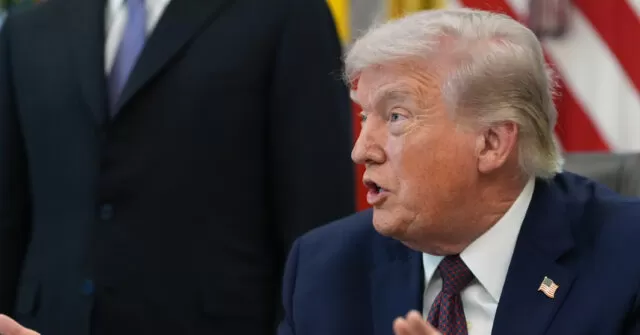
President Donald Trump has once again stirred up controversy with his latest statements regarding America’s membership in NATO. In a recent interview, Trump expressed his frustration with Europe’s lack of support in the Middle East and hinted at the possibility of withdrawing the United States from the alliance.
According to a British newspaper, Trump’s comments were made in response to the recent tensions between the United States and Iran. The President had called for direct aid from NATO in securing the Middle East from Iranian threats, but his request was met with silence from European leaders.
This perceived lack of support from Europe has led Trump to reconsider America’s role in NATO. In his own words, the alliance is a “paper tiger” that relies on the United States for its strength and protection, while offering little in return.
This is not the first time that Trump has expressed his dissatisfaction with NATO. Since taking office, he has repeatedly criticized European countries for not meeting their financial obligations to the alliance. While the United States continues to contribute the majority of NATO’s funding, many European countries fall short of their agreed-upon defense spending targets.
Trump’s comments have sparked a heated debate, with some praising his bold stance and others condemning it as a dangerous move that could weaken the alliance and undermine global security. However, one thing is clear – Trump’s call for Europe to step up and take on a more active role in NATO is not without merit.
For too long, the United States has carried the burden of NATO’s defense, while European countries have failed to fulfill their commitments. This imbalance not only puts a strain on America’s resources but also undermines the very purpose of the alliance – to promote collective security and deter potential threats.
In recent years, Europe has faced numerous security challenges, from the ongoing refugee crisis to the rise of extremist ideologies. Yet, instead of investing in their own defense and working together with the United States, many European countries have chosen to prioritize their domestic agendas.
Trump’s call for Europe to reciprocate America’s support and play a more active role in NATO is not unreasonable. It is time for European leaders to step up and take responsibility for their own security. As the saying goes, “with great power comes great responsibility,” and it is time for Europe to live up to its role as a global power.
Moreover, Trump’s comments should not be seen as a threat to the alliance, but rather as a wake-up call for Europe to re-evaluate its priorities and take action. By fulfilling their financial obligations to NATO and investing in their own defense capabilities, European countries can contribute to a stronger and more effective alliance.
It is also important to note that Trump’s call for Europe’s involvement in the Middle East is not without reason. The region is facing numerous security challenges, from the ongoing conflict in Syria to the threat of terrorism. As a global superpower, the United States cannot and should not bear the burden of securing the Middle East alone.
By working together with European allies, the United States can effectively address these challenges and promote stability in the region. This is not just in the interest of America, but also in the interest of Europe and the world at large.
In conclusion, President Donald Trump’s comments on reconsidering America’s membership in NATO should not be seen as a rash decision, but rather as a call for Europe to fulfill its obligations and play a more active role in the alliance. By doing so, Europe can demonstrate its commitment to global security and strengthen the alliance for the benefit of all its members. It is time for Europe to step up and show its strength as a global power.
