
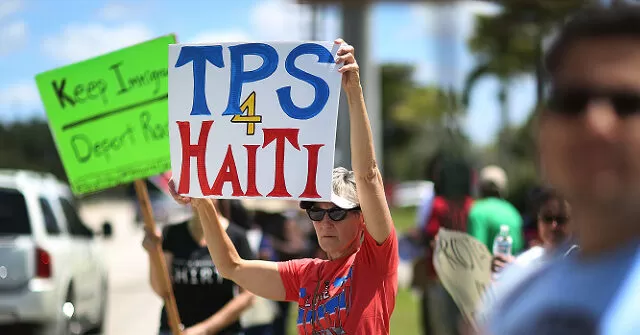
President Donald Trump’s administration has recently sparked controversy with their request to the Supreme Court to confirm the president’s authority to end a quasi-amnesty program for thousands of Haitian migrants currently residing in the United States. This move has been met with both support and criticism, with many wondering about the potential impact on the Haitian community and the nation as a whole.
The program in question, known as Temporary Protected Status (TPS), was instituted in 2010 after a catastrophic earthquake struck Haiti, leaving the country in shambles. TPS allows individuals from countries affected by natural disasters or armed conflicts to remain in the US temporarily and provides them with work permits. However, the Trump administration argues that the conditions in Haiti have improved significantly since the earthquake and that the country is now able to handle the return of its citizens.
In the request submitted to the Supreme Court, the administration also emphasized the fact that TPS was meant to be a temporary solution and should not be extended indefinitely. This aligns with President Trump’s broader stance on immigration, as he has consistently promised to put an end to what he believes are “loopholes” in the immigration system.
While some may view this request as a harsh and heartless move, it is essential to note that the Trump administration has also been working towards a permanent solution for the Haitian migrants. In 2019, the Department of Homeland Security announced that TPS for Haiti would be terminated in January 2021, giving individuals ample time to prepare for their return to their home country. Additionally, the administration has also urged Congress to pass legislation that would provide a pathway to citizenship for TPS recipients.
The decision to terminate TPS for Haitian migrants has not been an easy one, and it has been met with strong opposition from various groups, including immigration advocates and the Haitian community. Many argue that Haiti is still not in a stable enough condition to handle the return of its citizens, and that ending TPS would result in the separation of families and the loss of jobs for the affected individuals.
Despite the valid concerns raised by these groups, it is crucial to consider the bigger picture and the long-term impact of TPS. The program was never intended to be a permanent solution, and it is not fair to continuously extend it without addressing the root cause of the issue. By requesting the Supreme Court to confirm his authority to end TPS for Haitian migrants, President Trump is taking a necessary step towards enforcing the rule of law and ensuring that immigration policies are not exploited.
Furthermore, this move by the Trump administration sends a strong message to other countries that the US will not tolerate the misuse of temporary programs. It also highlights the need for comprehensive immigration reform to address the loopholes that have been taken advantage of in the past.
The Trump administration’s request to the Supreme Court is not an attack on the Haitian community, as some may portray it to be. Instead, it is a necessary step towards fixing a broken immigration system and upholding the rule of law. It is also a call to action for Congress to work towards finding a permanent solution for TPS recipients, including a pathway to citizenship for those who have followed the law and contributed positively to American society.
In conclusion, while there may be differing opinions on the termination of TPS for Haitian migrants, President Donald Trump’s request to the Supreme Court should be seen as a positive step towards addressing a larger issue. It is time for a comprehensive and fair solution to be reached, one that considers the well-being of all parties involved. Let us hope that this decision leads to constructive dialogue and meaningful change in our immigration policies.
