
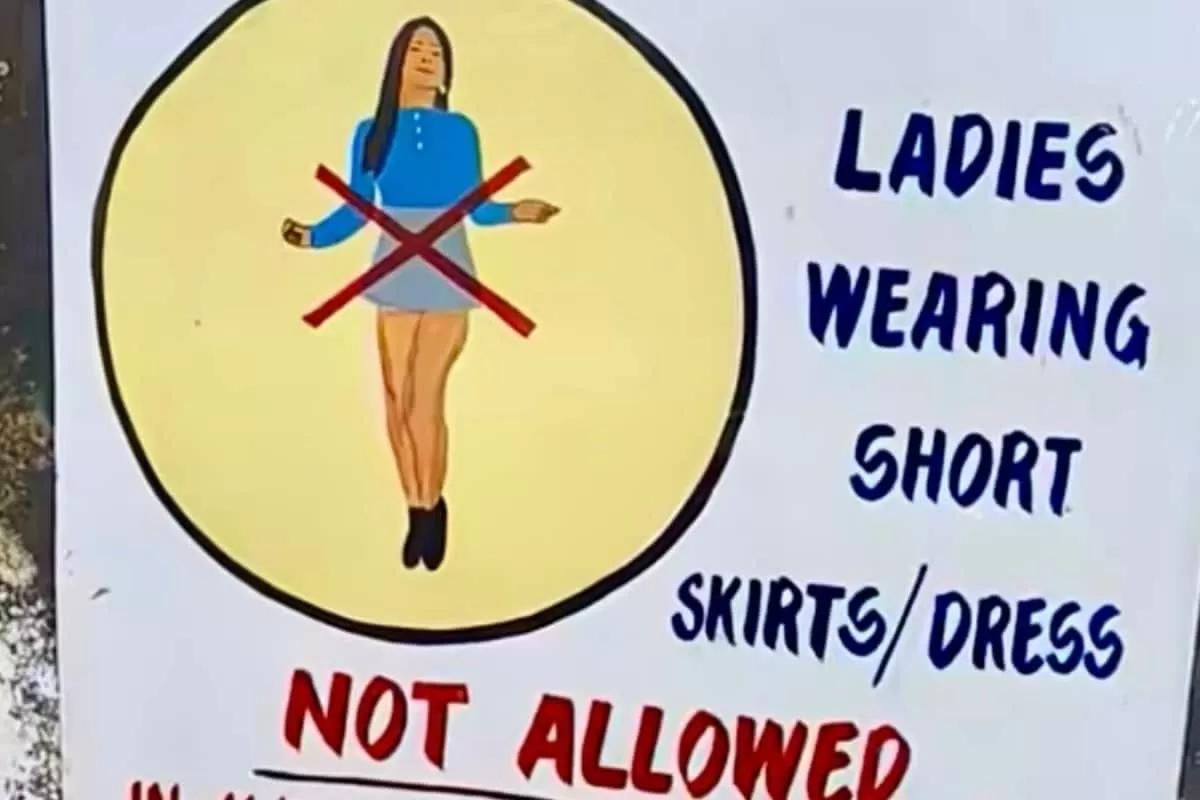
The Mahakal Temple in Darjeeling, a popular tourist destination in West Bengal, has recently made headlines for its decision to ban mini-skirts and short dresses within its premises. The temple, which is dedicated to Lord Shiva, has also offered ghagras (traditional Indian skirts) for rent to promote modesty among its visitors. This move has sparked a debate over tradition versus personal freedom, with some applauding the temple’s efforts to uphold cultural values while others questioning the restriction on individual choice.
The decision to ban mini-skirts and short dresses was made by the temple authorities after receiving complaints from devotees and locals about the increasing number of tourists wearing revealing clothing inside the temple premises. The temple, which is considered a sacred place by many, has always maintained a dress code for its visitors, but the recent rise in the number of tourists flouting the rules has prompted the authorities to take a stricter stance.
The temple’s decision has been met with mixed reactions. While some have praised the move, others have criticized it, calling it regressive and a violation of personal freedom. The ban has also sparked a debate on whether it is necessary to adhere to traditional values in a modern society.
On one hand, the temple’s decision can be seen as a step towards preserving cultural values and promoting modesty. The temple, which is visited by thousands of devotees every day, is a place of worship and should be treated with respect. The ban on revealing clothing can be seen as a way to maintain the sanctity of the temple and ensure that visitors dress appropriately while paying their respects to the deity.
Moreover, the temple’s offer to rent ghagras to those who are not dressed according to the dress code can be seen as a considerate gesture. This not only allows visitors to adhere to the temple’s rules but also gives them an opportunity to experience the traditional attire of the region. It also promotes local businesses and supports the community.
On the other hand, some argue that the ban on mini-skirts and short dresses is a violation of personal freedom. In a society that prides itself on being modern and progressive, such restrictions can be seen as regressive and a hindrance to individual choice. Many believe that what one chooses to wear should not be dictated by anyone else, and imposing a dress code goes against the principles of personal freedom.
Moreover, the ban has also raised questions about the definition of modesty and who gets to decide what is appropriate. In a diverse society like India, where people come from different backgrounds and cultures, it is difficult to have a universal definition of modesty. What may be considered modest in one culture may not be the same in another. Therefore, imposing a dress code can be seen as a way to impose one’s beliefs on others.
The debate over tradition versus personal freedom is not a new one. In a country like India, where tradition and culture hold a significant place, there is often a clash between the old and the new. While it is important to preserve our cultural values, it is also essential to embrace change and adapt to the evolving society. The ban on mini-skirts and short dresses may be seen as an attempt to hold on to traditional values, but it also raises questions about the need to evolve and accept new ideas.
In conclusion, the ban on mini-skirts and short dresses at the Mahakal Temple in Darjeeling has sparked a debate over tradition versus personal freedom. While some see it as a way to uphold cultural values and promote modesty, others view it as a violation of personal freedom. The temple’s decision has brought to light the ongoing struggle between tradition and modernity in our society. It is essential to find a balance between the two and respect individual choices while also preserving our cultural heritage.
