
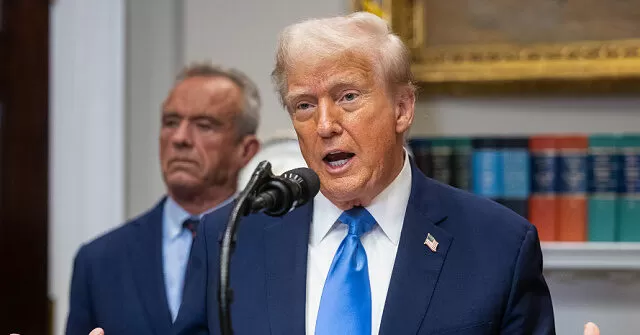
In a Monday press conference, President Donald Trump expressed his wish for the establishment media to show more openness towards finding the causes of autism. The President believes that if the media takes a collective effort in researching the origins of autism, effective solutions can be found. This statement from the President highlights his determination to better understand and address the growing problem of autism in our society.
Autism, a developmental disorder that affects communication and behavior, has been on the rise in recent years. According to the Centers for Disease Control and Prevention, 1 in 59 children are diagnosed with autism spectrum disorder (ASD), with boys being affected 4 times more than girls. This alarming increase in autism cases has left families and experts searching for answers.
But President Trump’s call for the media to join in the search for autism causes is not just about finding a reason for the increasing cases. It is also about finding effective treatments and interventions to improve the lives of those affected by autism and their families. The President believes that by understanding the causes of autism, we can better equip ourselves to provide proper care and support for individuals with ASD.
The media has a powerful influence on public perception. It has the power to shape opinions and drive discussions on important issues. Therefore, the President’s appeal for media involvement in researching autism causes is not without merit. Media outlets have a responsibility to use their platform to bring attention to important issues and facilitate meaningful dialogue. By joining the conversation on autism, the media can help raise awareness and educate the public about the disorder.
Unfortunately, the media’s coverage of autism has been limited and often biased. Many news outlets have perpetuated myths and misconceptions about autism, causing stigma and discrimination towards individuals with ASD. The President’s call for the media to show openness in investigating autism causes is also a call for more responsible and accurate reporting on the disorder.
President Trump’s stance on autism is not new. He has previously spoken about his belief that vaccinations could be linked to the rising cases of autism. While this has been a contentious issue, the President’s support for finding the root causes of autism should not be dismissed. As a leader, he has a role to play in promoting the well-being of his citizens, and addressing the growing concern of autism is undoubtedly part of that responsibility.
Some may argue that the government should be solely responsible for finding solutions to public health issues like autism. However, the President’s call for media involvement is not about shirking responsibility, but rather about harnessing all avenues for finding solutions. With the media’s wide reach and influence, partnering with them in the fight against autism can greatly benefit the cause.
One cannot deny that President Trump’s words have the potential to spark change. His call for media involvement in autism research shows his willingness to take unconventional approaches to tackling important issues. And in the case of autism, there is a great need for fresh perspectives and innovative solutions.
In conclusion, President Trump has highlighted the need for the media to show more openness towards finding the causes of autism. His call for collective efforts in researching and understanding this disorder is a step in the right direction. With increased media attention and responsible reporting, we can raise awareness and drive meaningful discussions on autism. Let us join hands in this endeavor to create a better world for individuals with autism and their families.
