
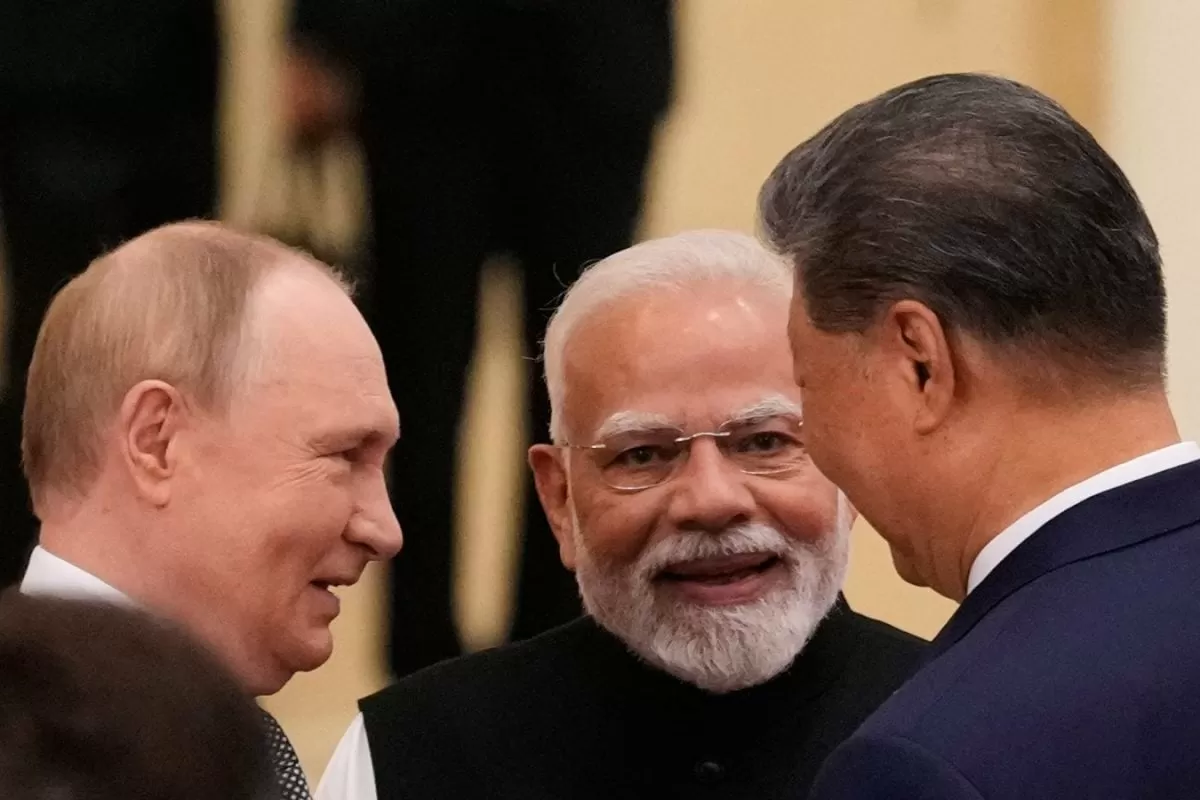
The global political landscape has always been a complex and constantly evolving one. And at the center of it all, lies the delicate balancing act between the three superpowers – the United States, China, and Russia. This has always been a critical test for Bharat’s foreign policy framework, which is centered on the principle of strategic autonomy. Bharat, also known as India, has consistently strived to maintain an independent and non-aligned stance in its foreign relations, and this has been put to the test with the ever-changing dynamics of the US-China-Russia triangle.
The United States, often hailed as the world’s superpower, has been a key ally of Bharat since its independence. The two countries share strong economic and cultural ties, and the US has been a major contributor to Bharat’s growth and development. However, in recent times, the US has been increasingly assertive in its foreign policies, particularly towards China and Russia. This has put Bharat in a tight spot, as it tries to maintain its strategic autonomy while also not jeopardizing its relationship with the US.
On the other hand, China, with its growing economic and military might, has become a major player in global politics. Its close ties with Pakistan, a country with a long-standing conflict with Bharat, have always been a cause of concern for the latter. Additionally, China’s aggressive stance in the South China Sea and its Belt and Road Initiative have raised eyebrows in the international community. Bharat, with its own territorial disputes with China, has had to tread carefully in its relations with the country.
Russia, a long-time ally of Bharat, has also been a key player in the US-China-Russia triangle. The country has been facing sanctions from the US and its relationship with China has been growing stronger. This has put Bharat in a difficult position, as it tries to maintain its strategic autonomy while also not getting caught in the crossfire between its two allies.
In the midst of these complex and often conflicting relationships, Bharat has managed to maintain its strategic autonomy through its foreign policy framework. This framework is based on the principles of non-alignment, mutual respect, and peaceful co-existence. It has allowed Bharat to maintain friendly relations with all three superpowers while also safeguarding its own national interests.
One of the key elements of Bharat’s foreign policy is its commitment to non-alignment. This means that Bharat does not align itself with any particular power bloc or alliance, and instead maintains an independent stance in its foreign relations. This has allowed Bharat to engage with all three superpowers without being tied down by any specific alliance. It has also enabled Bharat to exercise its own foreign policy decisions, without being influenced by the agendas of other countries.
Mutual respect is another crucial aspect of Bharat’s foreign policy framework. It believes in respecting the sovereignty and territorial integrity of other nations, and expects the same in return. This has allowed Bharat to maintain cordial relations with all three superpowers, despite their conflicting interests. It has also helped Bharat to play a role of mediator in resolving disputes between these powers.
The principle of peaceful co-existence is also deeply ingrained in Bharat’s foreign policy framework. It believes in maintaining peaceful relations with all nations, and not getting involved in conflicts that do not directly concern it. This has allowed Bharat to stay out of the US-China-Russia triangle and focus on its own development and growth.
Bharat’s strategic autonomy has also been reflected in its approach towards international organizations. It has maintained a careful balance in its participation in global forums like the United Nations and BRICS, without taking sides in any power struggle. This has allowed Bharat to effectively voice its opinions and contribute to global decision-making, while also safeguarding its own interests.
In recent times, Bharat has also been actively pursuing its “Neighborhood First” policy, which aims to strengthen its ties with neighboring countries. This has been a strategic move to counter China’s growing influence in the region. By building strong relationships with its neighbors, Bharat has been able to create a buffer against China’s expansionist policies.
It is evident that maintaining strategic autonomy amidst the complex relations between the US, China, and Russia is no easy task. But Bharat’s foreign policy framework, centered on the principles of non-alignment, mutual respect, and peaceful co-existence, has allowed it to navigate through these challenges successfully. It has enabled Bhar
