
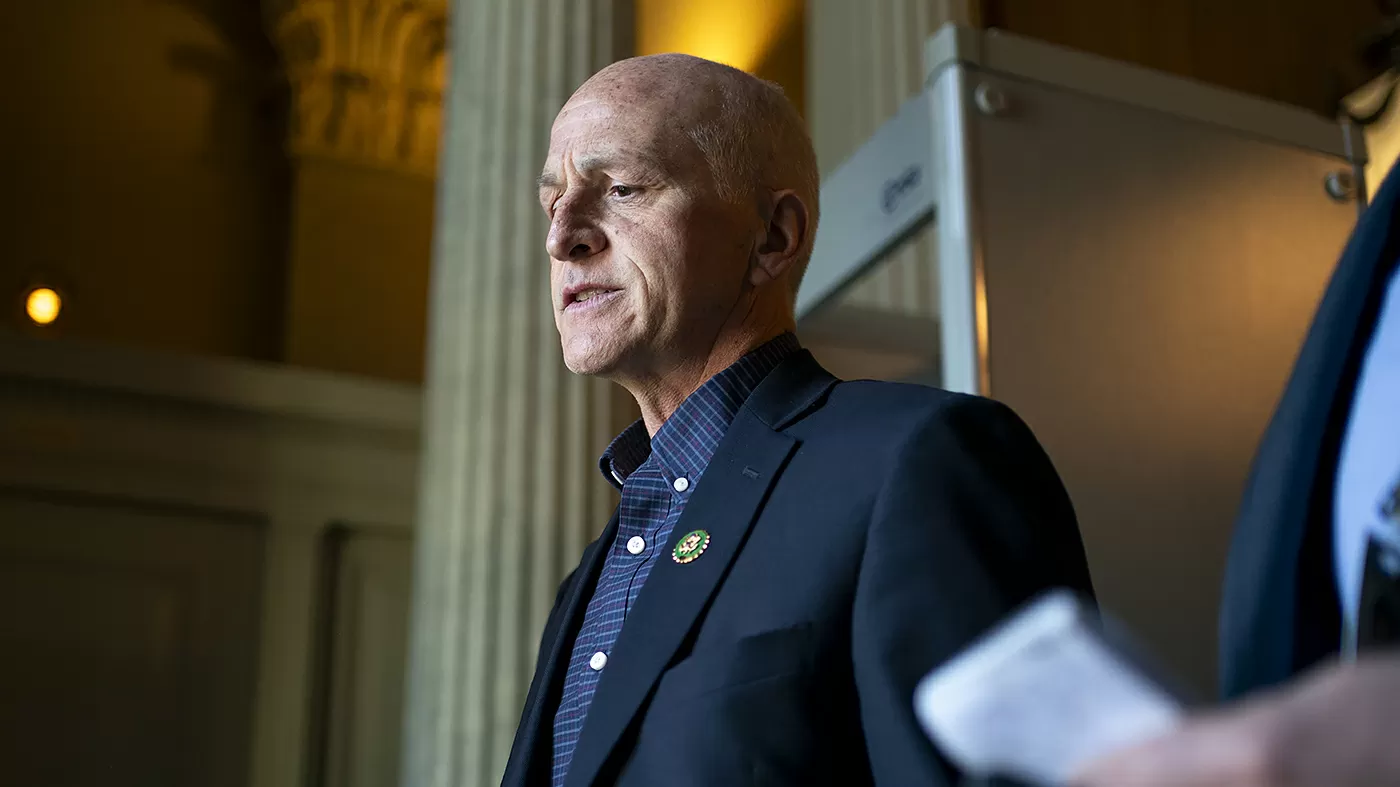
Rep. Adam Smith (D-Wash.) has spoken out against President Trump’s recent decision to strike Iranian nuclear facilities, stating that the attacks may not have the intended outcome that the President claimed in his announcement of the military action on Saturday evening.
In an interview on MSNBC, Rep. Smith, who serves as the top Democrat on the House Armed Services Committee, expressed his doubts about the effectiveness of the strikes in deterring Iran’s nuclear program. He questioned the President’s assessment that the strikes would be a “death blow” to the Iranian nuclear sites.
“This is not necessarily the death blow that President Trump has claimed it to be,” Rep. Smith stated. “I have my doubts about whether these strikes will have the desired effect.”
The strikes were carried out in response to Iran’s recent increase in nuclear activity, including the enrichment of uranium beyond the levels allowed by the 2015 nuclear deal. President Trump has consistently criticized the deal and withdrew the United States from it in 2018.
However, Rep. Smith believes that the strikes may do more harm than good in the long run. “While I understand the need to send a message to Iran, we have to consider the consequences of our actions,” he said. “Iran may see this as an act of aggression and retaliate, leading to a dangerous escalation of tensions in the region.”
Rep. Smith’s concerns are not unfounded. In the past, Iran has responded to U.S. military actions with its own retaliatory measures, which could have devastating consequences for both countries and the entire Middle East.
The Congressman also questioned the legality of the strikes, as they were carried out without the approval of Congress. As a member of the House Armed Services Committee, Rep. Smith emphasized the importance of Congressional oversight in matters of military action. “The Constitution gives Congress the power to declare war, and in this case, the President acted unilaterally without consulting with Congress,” he stated.
Rep. Smith’s remarks have sparked a debate among lawmakers and experts, with some supporting the President’s decision and others expressing concern over the potential consequences.
In the midst of all this, President Trump has continued to defend his actions, stating that they were necessary to protect U.S. interests and prevent Iran from obtaining nuclear weapons. However, his claim that the strikes were a “decisive blow” to Iran’s nuclear program has been met with skepticism.
Many experts believe that the Iranian regime is resilient and will likely continue to pursue its nuclear ambitions despite the strikes. In fact, Iran’s leaders have already declared that they will take further steps to increase their nuclear capabilities in response to the attacks.
The situation between the U.S. and Iran remains tense, and there are valid concerns about the potential for further military action and escalation of tensions. As Rep. Smith pointed out, diplomacy and a deep understanding of the consequences of our actions are crucial in dealing with such sensitive matters.
It is important for the U.S. to carefully consider its next steps and work towards a peaceful resolution to the current crisis. As a nation, we cannot afford to make decisions that could have dire consequences for not only our own country but also the entire world.
The international community, including our allies, must also play a role in bringing stability to the region. Dialogue and cooperation are key in avoiding further conflict and finding a lasting solution to the ongoing tensions between the U.S. and Iran.
In conclusion, Rep. Adam Smith’s comments on the recent strikes on Iranian nuclear facilities serve as a reminder for the need for careful deliberation and consideration in matters of military action. It is crucial for the U.S. to prioritize diplomacy and seek peaceful solutions to issues that have the potential to impact the entire world.
