
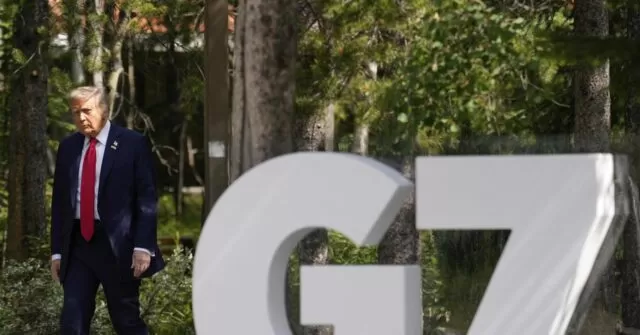
President Donald Trump has once again made headlines with his bold decision to reject the G7’s proposed statement on Iran. The statement, which called for monitoring of Iran’s nuclear activities, was deemed insufficient by the US President who is pushing for a total end to Iran’s program of nuclear enrichment.
The G7 summit, which was held in Biarritz, France, saw leaders from the world’s most powerful economies come together to discuss various global issues. One of the key topics on the agenda was the escalating tensions between the United States and Iran. The G7 leaders were hoping to release a joint statement that would address the issue and ease the growing concerns of the international community.
However, President Trump’s refusal to sign the statement has caused a stir among the G7 members. The US President has been vocal about his stance on Iran’s nuclear program, which he believes poses a significant threat to global security. In his view, the only solution to this issue is a complete halt to Iran’s nuclear enrichment activities.
The G7 statement, on the other hand, called for monitoring of Iran’s nuclear activities through the International Atomic Energy Agency (IAEA). This approach was seen as a more diplomatic and cautious approach by the other G7 leaders. However, President Trump was not convinced and stood firm on his demand for a total end to Iran’s nuclear enrichment.
This bold move by President Trump has once again showcased his strong leadership and unwavering determination to protect the interests of the United States and its allies. The US President has been consistent in his stance on Iran’s nuclear program, and his refusal to sign the G7 statement is a clear message to the world that he will not back down from his demands.
President Trump’s decision has also been praised by his supporters and allies who see it as a necessary step in dealing with Iran’s aggressive behavior. The US has been at odds with Iran since President Trump withdrew from the 2015 nuclear deal, which he deemed as “the worst deal ever.” The US has since imposed strict economic sanctions on Iran, which have crippled its economy and put pressure on the Iranian government to come to the negotiating table.
The G7 summit was seen as an opportunity for the US and its allies to present a united front against Iran and address the growing concerns over its nuclear program. However, President Trump’s refusal to sign the statement has once again highlighted the differences in approach between the US and its allies.
In his typical bold and straightforward style, President Trump has made it clear that he will not settle for anything less than a complete end to Iran’s nuclear enrichment. This move has also sent a strong message to Iran that the US will not tolerate any further aggression or attempts to develop nuclear weapons.
The US President’s decision has also been supported by his National Security Advisor, John Bolton, who has been a vocal critic of the 2015 nuclear deal. Bolton has stated that the US will continue to put pressure on Iran until it agrees to end its nuclear program completely.
In conclusion, President Trump’s rejection of the G7 statement on Iran has once again shown his strong leadership and determination to protect the interests of the United States and its allies. His refusal to settle for anything less than a complete end to Iran’s nuclear enrichment is a clear indication that the US will not back down from its demands. This move has also sent a strong message to Iran that the US will not tolerate any further aggression or attempts to develop nuclear weapons. The world will now wait and see how Iran responds to this bold move by the US President.
