
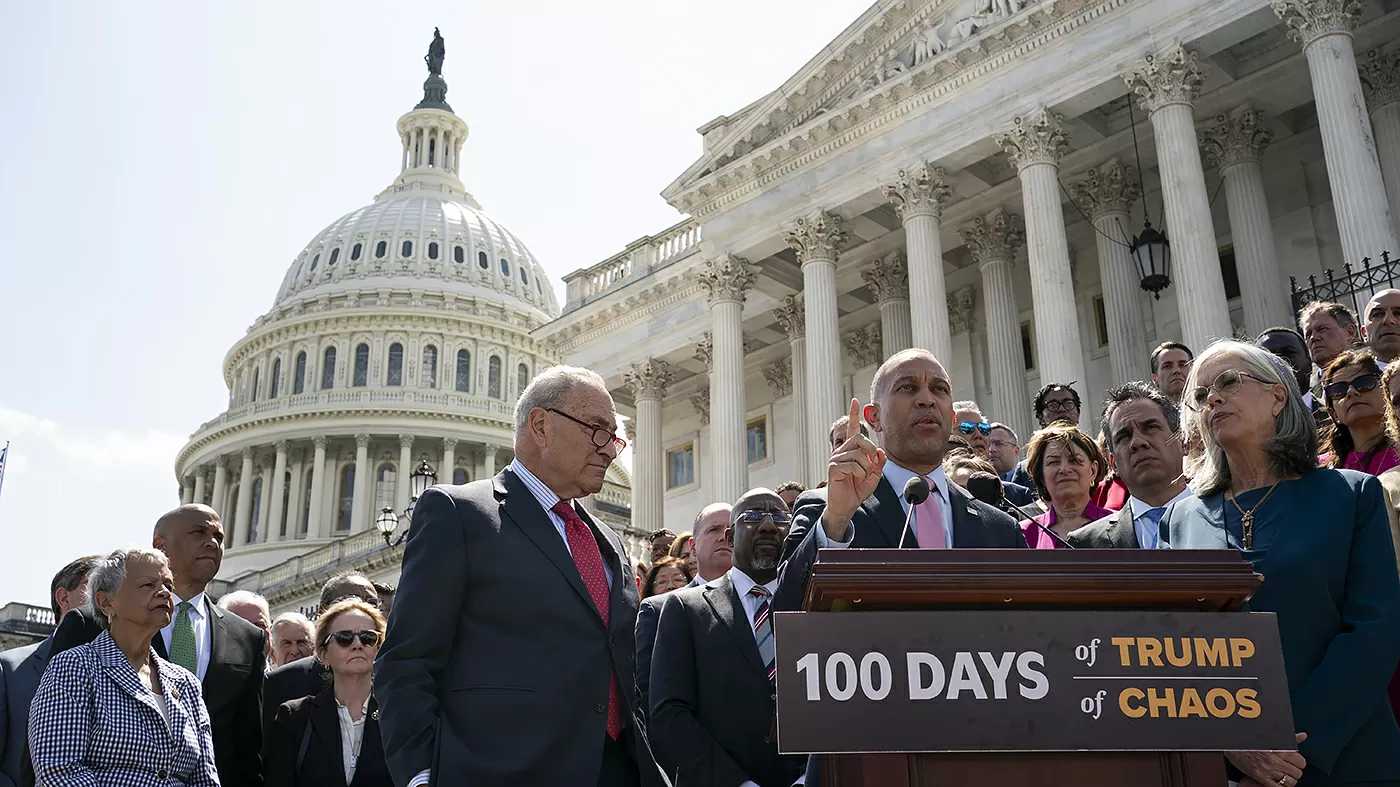
Democratic leaders in the United States are currently facing a Goldilocks dilemma. On one hand, they are being pressured by the left to take a more aggressive stance against President Trump and his administration. On the other hand, they are also facing pressure from the center to be less antagonistic and even cooperate with the duly elected government. This delicate balancing act has left Democratic leaders in a difficult position, both on and off Capitol Hill.
The current political climate in the United States is highly polarized, with deep divisions between the left and the right. This has only been exacerbated by the election of President Trump, who has been a controversial figure since the beginning of his campaign. As a result, the left has been pushing for Democratic leaders to take a more confrontational approach towards the Trump administration, viewing it as a threat to their values and beliefs.
On the other hand, there are those in the center who believe that the best way to move forward is through cooperation and compromise. They argue that constantly being in opposition to the administration will only further divide the country and hinder progress. They also believe that it is important to respect the democratic process and the will of the people, even if they do not agree with the outcome.
This Goldilocks dilemma has put Democratic leaders in a difficult position. They are being pulled in two different directions, with no clear solution in sight. However, it is important for them to find a middle ground that will not only satisfy both sides but also benefit the country as a whole.
One of the main challenges for Democratic leaders is to find a way to effectively oppose the policies and actions of the Trump administration without being seen as obstructionist. This requires a delicate balance of standing up for their beliefs and values while also being open to working with the other side when it is in the best interest of the country.
It is also important for Democratic leaders to listen to the concerns of their constituents and address them in a meaningful way. The left is not just calling for resistance, but also for concrete actions and policies that align with their values. By actively listening and responding to these concerns, Democratic leaders can show that they are not just blindly opposing the administration, but are also working towards creating a better future for all Americans.
At the same time, it is crucial for Democratic leaders to maintain a level of civility and respect in their interactions with the Trump administration. While it is important to hold the administration accountable, resorting to personal attacks and name-calling will only further divide the country and hinder progress. By taking the high road and remaining professional, Democratic leaders can set an example for the rest of the country and show that they are capable of leading with integrity and dignity.
Ultimately, the Goldilocks dilemma facing Democratic leaders is a test of their leadership skills. It requires them to navigate through difficult and uncertain times, while also staying true to their values and principles. It is not an easy task, but it is one that they must undertake in order to effectively represent their constituents and move the country forward.
In conclusion, the Goldilocks dilemma facing Democratic leaders is a challenging one, but it is not insurmountable. By finding a balance between resistance and cooperation, actively listening to their constituents, and maintaining a level of civility, Democratic leaders can effectively navigate through these turbulent times. It is important for them to remember that their ultimate goal is to serve the people and work towards a better future for all Americans, regardless of their political beliefs.
