
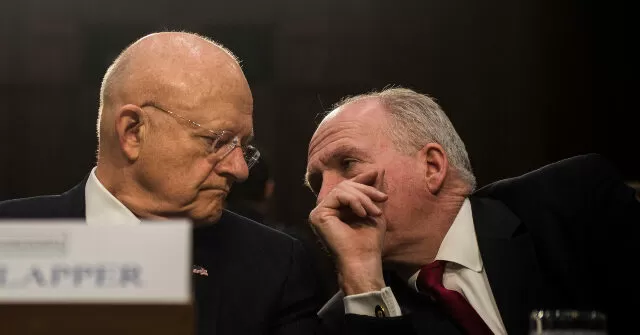
In a recent development, a group of deep state actors, including former Director of National Intelligence James Clapper and former CIA Director John Brennan, have urged Congress to reauthorize Section 702 of the Foreign Intelligence Surveillance Act (FISA) without any reforms. This move has sparked a debate among lawmakers and the public about the necessity and implications of this controversial spy powers authority.
Section 702 of FISA allows the National Security Agency (NSA) to collect and store the electronic communications of foreign individuals outside the United States, even if they are communicating with American citizens. However, it has been criticized for its potential to violate the privacy and civil liberties of American citizens.
Despite these concerns, Clapper and Brennan, along with other deep state actors, have come forward to defend the reauthorization of Section 702 without any reforms. They argue that this authority is crucial for national security and has been instrumental in preventing terrorist attacks on American soil.
In a joint statement, Clapper and Brennan stated, “Section 702 has been a critical tool in our fight against terrorism and other national security threats. It has provided valuable intelligence that has helped us identify and disrupt plots against our country and our allies.”
They further emphasized that Section 702 has strong oversight mechanisms in place to ensure that it is not abused. This includes regular audits by the Department of Justice and the Office of the Director of National Intelligence, as well as approval from the Foreign Intelligence Surveillance Court (FISC) for any surveillance activities.
The deep state actors also highlighted the importance of Section 702 in gathering intelligence on foreign threats, such as cyber attacks and espionage. They argued that without this authority, the United States would be at a significant disadvantage in the global arena.
Moreover, Clapper and Brennan pointed out that Section 702 has strict limitations on the collection of information on American citizens. They stated, “Contrary to popular belief, Section 702 does not allow for the wholesale collection of Americans’ communications. Any incidental collection of such information is subject to strict minimization procedures and is only used for national security purposes.”
Their statement comes at a crucial time as Congress is set to vote on the reauthorization of Section 702 before it expires at the end of the year. The deep state actors’ support for the reauthorization without any reforms has been met with criticism from civil liberties groups and some lawmakers who argue that this authority needs to be reformed to protect the privacy of American citizens.
However, the deep state actors’ strong defense of Section 702 has also garnered support from other lawmakers who believe that this authority is essential for national security. Senator Richard Burr, the chairman of the Senate Intelligence Committee, stated, “Section 702 is a vital tool in our fight against terrorism and other threats to our nation. It has been used responsibly and effectively, and I fully support its reauthorization without any changes.”
In conclusion, the deep state actors’ call for the reauthorization of Section 702 without any reforms has sparked a heated debate among lawmakers and the public. While concerns about privacy and civil liberties must be taken into consideration, it is also crucial to acknowledge the vital role that this authority plays in protecting national security. As Congress prepares to vote on the reauthorization, it is essential to strike a balance between these two important factors to ensure the safety and well-being of the American people.
