
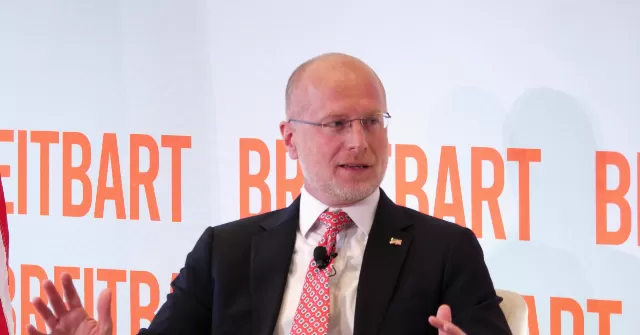
In a recent policy event hosted by Breitbart News, Federal Communications Commission (FCC) Chairman Brendan Carr made a bold statement about the agency’s efforts under President Donald Trump. According to Carr, the FCC has been actively working towards reversing internal diversity, equity, and inclusion (DEI) initiatives while also encouraging telecommunications companies to prioritize performance and meeting customer needs. This move, according to Carr, is aimed at removing any “invidious forms of DEI discrimination” within the industry.
Carr’s remarks have sparked a heated debate among industry experts and the general public. While some have praised the FCC’s actions as a step towards promoting fairness and meritocracy, others have raised concerns about the potential consequences of such a move. However, one thing is clear – the FCC, under the leadership of President Trump, is determined to bring about positive changes in the telecommunications sector.
During his speech, Carr highlighted the FCC’s efforts in promoting a level playing field for all players in the industry. He emphasized the need for telecom companies to focus on performance and meeting the needs of their customers, rather than getting caught up in DEI initiatives that may not necessarily lead to tangible results. This approach, according to Carr, will not only benefit the companies but also the consumers who rely on their services.
The FCC’s stance on DEI initiatives has been met with mixed reactions. While some have criticized the move as regressive, others have applauded it as a necessary step towards promoting a fair and competitive market. However, it is important to note that the FCC’s actions are not aimed at disregarding diversity and inclusion altogether. Instead, the agency is focused on promoting a more practical and results-driven approach to DEI.
Under the leadership of President Trump, the FCC has been actively working towards creating a more business-friendly environment for telecom companies. This has been evident in the agency’s efforts to roll back regulations and promote innovation in the industry. By encouraging companies to prioritize performance and customer needs, the FCC is not only promoting healthy competition but also paving the way for a more efficient and customer-centric telecom sector.
Carr’s remarks also shed light on the potential consequences of DEI initiatives that are not backed by solid evidence and data. He pointed out that such initiatives may lead to discrimination against certain groups, rather than promoting diversity and inclusion. This is a valid concern that needs to be addressed, especially in an industry as crucial as telecommunications.
The FCC’s stance on DEI initiatives is in line with President Trump’s vision of promoting a merit-based society. By encouraging companies to focus on performance and customer needs, the agency is promoting a fair and competitive market where success is determined by merit, rather than factors such as race or gender. This approach is not only beneficial for businesses but also for society as a whole.
In conclusion, the FCC’s efforts under President Trump to reverse internal DEI initiatives and promote a more practical approach to diversity and inclusion have sparked a much-needed conversation about the role of such initiatives in the telecommunications industry. While there may be differing opinions on the matter, one thing is certain – the FCC is committed to promoting a fair and competitive market that benefits both businesses and consumers. As the industry continues to evolve, it is important for all stakeholders to work together towards creating a more inclusive and efficient telecom sector.
