
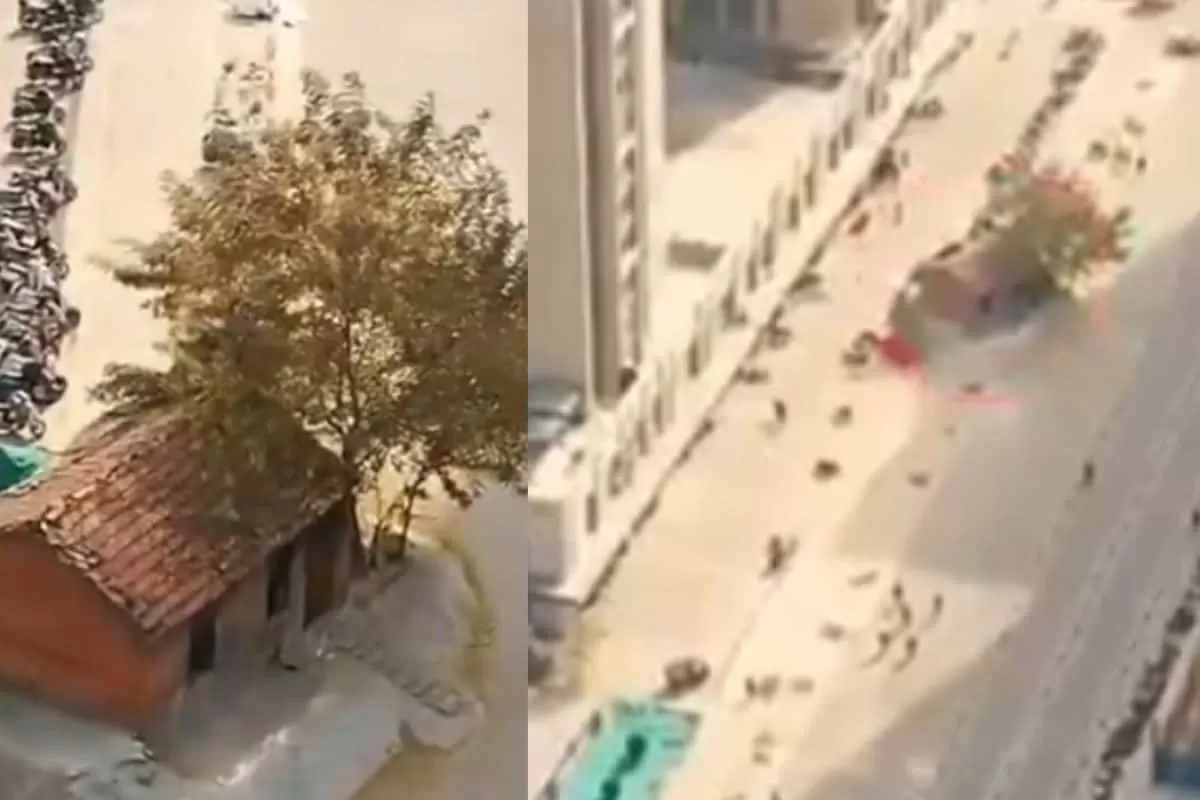
A nail house, also known as a dingzihu, is a term used to describe a home whose owners refuse to move or accept compensation for its demolition in the face of property redevelopment projects. These houses are often seen as an obstacle to progress, but they also represent the resilience and determination of their owners.
The concept of a nail house originated in China, where rapid urbanization and development have led to the displacement of many residents. In the early 2000s, the Chinese government implemented a series of property redevelopment projects in order to modernize and revitalize cities. This resulted in the forced relocation of many residents, who were often given inadequate compensation for their homes.
Amidst this landscape of change and upheaval, some homeowners stood their ground and refused to give up their homes. These homes, with their stubborn owners, became known as nail houses. The term “nail house” comes from the idea that these houses are like a nail that cannot be hammered down, a symbol of resistance and defiance.
The reasons for these homeowners’ refusal to leave their homes vary. Some may have a strong emotional attachment to their homes, having lived there for generations. Others may see their homes as a symbol of their hard work and success, and are unwilling to give them up for a small sum of money. For some, it may simply be a matter of principle and standing up against the powerful forces of development.
Whatever their reasons may be, these homeowners are often faced with immense pressure and even harassment from developers and local authorities. In some cases, they have been cut off from basic utilities and services, making their lives difficult. However, they continue to hold on, determined to protect what is rightfully theirs.
The nail house phenomenon has gained attention and admiration from people around the world. These homeowners have become symbols of resistance against the unstoppable forces of progress and development. They have also highlighted the flaws in the government’s approach to urban development, which often prioritizes economic growth over the well-being of its citizens.
One of the most famous nail houses in China is the “Nail House in the Middle of the Road” in Chongqing. In 2007, the owner, Wu Ping, refused to sell her home to make way for a new road. The authorities demolished all the surrounding buildings, leaving her house standing alone in the middle of the road. Despite facing immense pressure and threats, Wu Ping refused to back down and eventually, the government had to change the route of the road to go around her house.
Another notable nail house is the “Nail House in the Sky” in Guangzhou. The owner, Luo Baogen, refused to sell his home to make way for a new high-rise building. The developers had already begun construction around his house, leaving it perched on top of a 10-meter tall mound of earth. In the end, the developer had to build the high-rise building around Luo’s house, creating a unique and eye-catching sight.
These nail houses have become symbols of hope and inspiration for those who feel powerless in the face of development. They show that ordinary people can stand up against powerful forces and make a difference. They also serve as a reminder that a person’s home is more than just a physical structure, it is a place of memories, dreams, and a sense of belonging.
The phenomenon of nail houses is not limited to China. Similar cases have been reported in other countries such as the United States and India. In Seattle, Washington, a homeowner refused to sell her house to make way for a new shopping center. The developers eventually built the shopping center around the house, which is now known as the “Edith Macefield House.”
While some may see nail houses as a hindrance to development, they also serve as a reminder to consider the needs and rights of individuals in the pursuit of progress. These homeowners are not just fighting for their homes, they are fighting for their rights and the rights of others who may face similar situations in the future.
In conclusion, nail houses represent the human spirit of resilience and determination. They stand as a symbol of hope and inspire us to stand up for what we believe in. These homeowners may be seen as “nails” in the eyes of developers, but they are the true heroes who remind us that progress should not come at the cost of people’s homes and livelihoods.
